29 April 2009

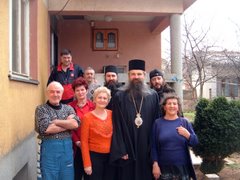
Bishop Artemije Demands Excavation at Monastery Be Stopped

Bishop Artemije demands that excavation works be stopped‏
From: Diocese of Ras-Prizren and Kosovo-Metohija (info@eparhija-prizren.com)

April 28, 2009.

Source: Diocese of Ras-Prizren and Kosovo-Metohija


COMMUNIQUE


BISHOP ARTEMIJE DEMANDS THAT EXCAVATION WORKS BE STOPPED


Usurpation of property rights at Monastery Graèanica


Without knowledge or permission of His Grace Artemije, Bishop of Raška-Prizren and Kosovo-Metohija, work is in progress on the excavation for pylons of the aerial power distribution network on the property of Monastery Graèanica. The work is being carried out by illegal institutions in Kosovo-Metohija.


In addition to violating internationally recognized property rights and threatening the safety of a religious and cultural site of exceptional significance for the Republic of Serbia, a site, moreover, included in the List of cultural monuments and natural heritage of the world, this act shows the extent of lawlessness which weighs heavily on Kosovo-Metohija.


Bishop Artemije has written to the Special Representative of the UN Secretary General, Mr. Zanier, demanding the immediate stoppage of works and initiating proceedings against person or persons responsible for the usurpation of the Monastery property.


Bishop Artemije has also written to the Minister of Mining and Power of the Republic of Serbia, Dr. Škundriæ expecting urgent intervention on the part of that Ministry.

17 April 2009

Patriarch Pavle's Paschal Epistle

Patriarchal Paschal Encyclical 2009 p. 1 of 5
The Serbian Orthodox Church to her spiritual children at Pascha, 2009
P A V L E
By the grace of God
Orthodox Archbishop of Pec, Metropolitan of Belgrade-Karlovci and Serbian Patriarch, with the all the Hierarchs of the Serbian Orthodox Church – to all the clergy, monastics, and all the sons and daughters of our Holy Church: grace, mercy and peace from God the Father, and our Lord Jesus Christ, and the Holy Spirit, with the joyous Paschal greeting:
CHRIST IS RISEN!
INDEED HE IS RISEN!
“Let us call ‘Brothers’ even those who hate us’
and forgive all by the resurrection.”
(Paschal hymn)
This year as well during these spring days, dear brothers and sisters, with the same joy we celebrate the greatest Feast Day of God’s Church, the Resurrection of Christ the Savior. Every year at this time, when the mysterious force of life awakens deadened nature, the glory of the Resurrected Lord awakens even in us a brighter, more holy and happier life. Today exalted thoughts spring forth, wonderful feelings are born, and a holy and extraordinary disposition overcomes us. With the resurrected Lord we also are raised up into a higher and more meaningful life. The victorious bliss of eternal life given to us by our Resurrected Redeemer and Savior shines forth in our hearts. Just as in that mysterious beginning at God’s Word the world was called into existence, and in the world life, so in like manner by His Divine power the Son of God, Jesus Christ, resurrected from the dead. This great event is mystical as is the creation of the world; it is miraculous and exalted as a real song of joy resounding throughout all God’s creation. Moreover, as the fulfillment of the first creation and as a new creation, it is even more miraculous and greater than the first creation and than all historical events.
Many centuries separate us from that bright Jerusalem dawn, when the holy Myrrhbearing women beheld the empty tomb. They came to anoint the dead body of their Teacher; to pour their tears upon it and to warm up the cold stones of the grave with their love, their faithfulness and devotion. They were at the cross of the Crucified Savior when all, except His Mother and one of the disciples, forsook Him. Even from a distance they followed the last moments of the greatest Teacher.
Patriarchal Paschal Encyclical 2009 p. 2 of 5
They did not forsake Him even when He died. That is why they were made worthy to be the first witnesses and the first messengers of the Resurrection; the first celebrants of the new life in the Resurrected Lord. Today the tender admonition uttered to the women by the Lord’s angel from the stone at the tomb resonates in our ears: “Why do you seek the living among the dead? He is not here, He is risen!” (Luke 24:5-6) And the frightened women, there in the garden where the tomb was, were the first ones to meet the Resurrected Lord. He sent them to Galilee to tell the disciples and to gladden them with the joyous news that they too would see Him (cf. Mark 16:7). And behold, dear children of God, this Resurrectional joy of ours today comes from that meeting with the Resurrected Lord, Who resurrected for us and instilled the joy of new life in all His followers and all the confessors of His Divine knowledge.
In the same way, the centuries separate us from the twilight of that Jerusalem day when the Resurrected Lord appeared to His followers, Cleopas and the other disciple. Frightened, they were hurrying from Jerusalem to Emmaus, so as to hide because of fear of the Jews. Even though they were not as courageous as the myrrhbearing women, they were made worthy of meeting with the Resurrected Lord. He hid His former image so that they could not recognize Him. But when He left them after a conversation about that which had taken place in Jerusalem and after the breaking of the bread, they confessed to one another how “their hearts were burning” while He was with them (cf. Luke 24:13-32). That same holy flame that burned in the hearts of Christ’s two disciples on the road to Emmaus burns even today in us as we celebrate this Feast of Feasts, as we too experience a spiritual meeting with the invisible Vanquisher of death. That same fire warmed and warms God’s Church in every period of her history. Did He not Himself say: “I have come to send fire upon the earth” (Luke 12: 49). That same holy fire warmed our ancestors and enlightened their lives in the dungeons of other centuries. They lived without homes for a long time, without homesteads, without freedom, in extreme insecurity, without possessions and property, as do many today who have been forced to leave their homesteads, but always with faith in the resurrected Lord, with the faith in the victory of justice and truth and with faith in the resurrection.
Furthermore, long centuries separate us from that first resurrectional evening, when the Resurrected Lord for the first time appeared to His frightened and disappointed disciples, and uttered a greeting of encouragement: “Peace be unto you!” (John 20:19). In an instant He returned peace to them, resurrecting their faith in Him and in His Divine dispensation. If the Son of God did not rise again, the history of Christianity would have been finished with His last words on the Cross: “It is finished!” (John 20:30). But He did rise again, and in the name of that truth His disciples joyfully gave up their lives for Him. Bearing this great truth, His
Patriarchal Paschal Encyclical 2009 p. 3 of 5
Church has gone into victorious battle throughout the world, that without shedding blood she may conquer her numerous armed-to-the-teeth enemies.
“Why do you seek the living among the dead?” (Luke 24:5), the angel of the Lord admonished the holy Myrrhbearing Women who came to the tomb, as you have heard. They came to the tomb thirsty for truth and eternal life. And today millions and millions of spiritually impoverished and morally ravaged people, enthralled with the grandeur of passing things, live in this world as in a cold tomb. Is the world not becoming a factory and a market place of false brilliance and passing values? Is it not often said today that a man can walk peacefully upon this earth without heaven? It is as if contemporary man has climbed the heights of his Babylonian tower, confident in his own knowledge, but he is often petty, selfish, aggressive, and full of evil intentions that threaten his tower and his survival. We are afraid that this our civilization will too late remember Christ’s words: “Without me you can do nothing” (John 15:5).
Our Savior became man so that we might become divine. He was willing to die on the cross in order to save mankind from their sins. He rose again from the dead in order to give us eternal life. He made death just another event in life – a life that knows no end. When Pilate judged the Savior, he had neither the spiritual strength nor the elevated mind to recognize in Him the Son of God. Despite all of this, the beauty of the human image of the suffering Savior could not be hidden before his eyes as he pronounced his sentence: “Behold, the man!” –to Jesus’ accusers (John 19:5). With this he attempted to influence, as much as possible, the conscience of the insensible murderers of Christ. He believed that His human brilliance would waver some of them.
We pray to our Resurrected Lord that in us may be resurrected the image of the original human nature, which today oftentimes is distorted, masked and smeared with numerous faults and sins. We pray that in us everyone may recognize people enlightened with His eternal life, be they wealthy or poor, be they in a great or small position or place. Our time is currently faced with a material crisis, but we currently face a greater crisis, that of morals and character. We will rejoice if everyone who looks upon us can say: Here is a man! – so that everyone, friend or enemy, judge or accuser, may identify in us a true and authentic human being. Let us, dear brothers and sisters, preserve our human dignity, which was so exalted by our Resurrected Son of God. Let us preserve faith in the Resurrected Lord, love towards our neighbors, and truth and justice; a love towards everything good for which people yearn, but which without the help of the Resurrected Lord and His Gospel is not achievable. Let us pray to the Resurrected Lord and let us implore Him, as did the two disciples who traveled on the road to Emmaus, to stay with us. Let us pray that we may rejoice in Him; that we may draw strength from Him; that
Patriarchal Paschal Encyclical 2009 p. 4 of 5
we may be spiritually raised on high, so that we may not be overcome and carried away by the muddy floodwaters of our times.
Conveying this our message to all of our brothers and sisters, and most especially remembering today our faithful in Kosovo and Metohija, as well as our faithful worldwide, on all continents where Serbian Orthodox and all Orthodox Christians today celebrate the Resurrection of Christ, we, your Patriarch and all the Hierarchs of the Serbian Church, greet you with the greeting of Joy and New Life,
Christ Is Risen!
Indeed He Is Risen!
Given at the Serbian Patriarchate in Belgrade at Pascha 2009.
Your prayerful intercessors before the Risen Lord:
Archbishop of Pec, Metropolitan of Belgrade-Karlovci and Serbian Patriarch PAVLE with all the hierarchs of the Serbian Orthodox Church.
Metropolitan of Zagreb and Ljubljana JOVAN Metropolitan of Montenegro and the Coastlands AMPHILOHIJE Metropolitan of Midwestern America CHRISTOPHER Metropolitan of Dabro-Bosna NIKOLAJ
Bishop of Sabac-Valjevo LAVRENTIJE Bishop of Nis IRINEJ Bishop of Zvornik-Tuzla VASILIJE Bishop of Srem VASILIJE Bishop of Banja Luka JEFREM Bishop of Budim LUKIJAN Bishop of Canada GEORGIJE Bishop of Banat NIKANOR Bishop for America and Canada of the New Gracanica Metropolitanate LONGIN Bishop of Eastern America MITROPHAN Bishop of Zica CHRYSOSTOM Bishop of Backa IRINEJ Bishop of Great Britain and Scandinavia DOSITEJ Bishop of Ras and Prizren ARTEMIJE Bishop of Bihac and Petrovac CHRYSOSTOM Bishop of Osijek and Baranja LUKIJAN Bishop of Central Europe CONSTANTINE Bishop of Western Europe LUKA Bishop of Timok JUSTIN Bishop of Vranje PAHOMIJE Bishop of Sumadija JOVAN Bishop of Slavonia SAVA
Patriarchal Paschal Encyclical 2009 p. 5 of 5
Bishop of Branicevo IGNATIJE Bishop of Milesevo FILARET Bishop of Dalmatia FOTIJE Bishop of Budimlje and Niksic JOANIKIJE Bishop of Zahumlje and Hercegovina GRIGORIJE Bishop of Valjevo MILUTIN
Bishop of Western America MAXIM Bishop of Gornji Karlovac GERASIM
Bishop of Australia and New Zealand IRINEJ
Retired Bishop of Zahumlje and Hercegovina ATANASIJE Vicar Bishop of Hvostno ATANASIJE Vicar Bishop of Jegar PORFIRIJE Vicar Bishop of Lipljan TEODOSIJE Vicar Bishop of Dioclea JOVAN Vicar Bishop of Moravica ANTONIJE
THE ARCHDIOCESE OF OCHRID Archbishop of Ochrid and Metropolitan of Skoplje JOVAN Bishop of Polos and Kumanovo JOAKIM Bishop of Bregal and locum tenens of the Diocese of Bitolj MARKO
Vicar Bishop of Stobija David
[Path of Orthodoxy translation

16 April 2009

Serb Organs Taken By Albanians

Kosovo Albanians tortured Serb civilians
Apr 10, 2009
Former camp prisoner said that the military wing of the Kosovo Albanian separatist government that has been recognized by some western states was involved in torturing civilians in order to sell their organs, reports BBC.

An ethnic Albanian, the former prisoner of the camp at Kukes, in northeastern Albania close to the border with the Serbian province of Kosovo, told the BBC that he witnessed the ethnic Albanian forces torture Serbs to extract their organs while they were claiming to the western press to be victims of an alleged genocide by Serbia.

The man’s testimony was made to the BBC under condition he remained unidentified because he fears that he and his family will be killed by other Albanians.

“His family are terrified for his life,” wrote the BBC of the ethnic Albanian witness who saw the organized separatist Albanian torture of Serbs.

This is the first testimony that the western media has directly linked the current Kosovo Albanian separatist government in this Serbian province with vice such as organ trade that ethnic Albanian separatist have been implicated in.

“Sources told the BBC that Kosovo Serbs… were among an estimated 2,000 who went missing,” wrote the BBC.

BBC wrote that the so-called prime minister of Kosovo, Hashim Thaci, has denied the evidence of involvement in the organized organ trade of Serb bodies.

“Kosovo Prime Minister Hashim Thaci, the former KLA political director, has rejected the allegations,” wrote the BBC.

Most Western powers have recognized the proclamation of independence that these allegedly organ trading ethnic Albanian leaders in Kosovo have made.

The Finnish diplomat Martti Ahtisaari wrote a UN-rejected plan that was seeking to force Serbia to accept a loss of its sovereignty and its territorial integrity.

“When a person is mistreated… he cries out ‘oh mother’ in his own language,” said the Albanian source who heard Serbs being tortured by the Kosovo separatist government forces.

The beatings of Serbs were done in the night.

“The nights were very quiet, so you could hear them crying out… while they were being beaten, or afterwards.” told the witness to the BBC.

Separatists in Kosovo have said that they will assist the EU investigation into the organ trade claiming that they are in no way implicated.

April 10, 2009
SERBIANNA

Tags: Kosovo

14 April 2009

No Surrender

NEMA PREDAJE


Omladina Cikaga , sa sajtom "Cikaski Srbi", organizuje Vaskrsnju humanitarnu akciju za pomoc Srbima na Kosmetu pod nazivom Nema predaje uz blagoslov Srpske pravoslavne crkve. Planira se da akcija krene 10-og aprila 2009 .

Cilj akcije je sakupljanje novca za pomoc Srbima na Kosmetu, kao i budjenje nacionalne svesti kod Srba u Americi.

Plan ove humanitarne akcije je da se na jednostavan i efikasan nacin prikupi novac distribucijom silikonskih narukvica u bojama srpske trobojke sa natpisom : KOSOVO IS SERBIA ! www.NemaPredaje.net . Za to nam treba hiljadu pojedinaca koji bi svojom donacijom od 10 dolara podrzali ovu akciju i time pomogli one kojima je pomoc najpotrebnija – nasim Srbima na Kosmetu. Narukvice bi trebalo da se distribuiraju uz pomoc crkve, srpskih biznisa u Americi i internet prezentacija. Rezultati akcije ce biti objavljeni na internet stranici nase akcije “ Nema predaje” kao i fotografije sa Kosmeta kada se novac bude predavao.

Za vise informacija pogledajte sajt www.NemaPredaje.Net i www.CikaskiSrbi.com ,
kontakt E-Mail: info@NemaPredaje.net


--------------------------------------------------------------------------------

NO SURRENDER


Serbian youth of Chicago, together with the website "Cikaski Srbi" (Chicago Serbs) is starting Easter Charity action to help the Serbs in Kosovo and Metohija under the title " No Surrender-Nema Predaje" with blessing of the Serbian Orthodox Church. This action begins on 10th of April 2009.

The Purpose of action is to collect money to help the Serbs in Kosovo and Metohija,and a revival of national consciousness of the Serbs in America.

The humanitarian plan of this action is a simple and effective way to collect money by distribution of silicone bracelets in colors of Serbian flag with the inscription: KOSOVO IS SERBIA! www.NemaPredaje.net . For this action we need thousand of individuals with their donation of 10 dollars to support this action and help those who help need the most - our Serbs in Kosovo. Bracelets should be distributed with the help of the church, the Serbian businesses in the United States and Website presentations. Results of action will be published on the web page of our actions, "No Surrender" as well as photos from Kosovo when the money is donated.

For more information, see the website www.NemaPredaje.Net and www.ChicagoSerbs.info ,
E-Mail: info@NemaPredaje.net

Serbs in Kosovo Not Allowed to Worship In Reconstructed Churches?

April 14, 2009.

Source: Diocese of Ras-Prizren and Kosovo-Metohija


The Diocese of Ras-Prizren On the reconstruction of holy sites in accordance with the Memorandum


Reconstruction under the Memorandum gives no legal rights

participating factors


In the pogrom which the Albanians carried out against the Serbian people and Serbian cultural patrimony on March 17 and 18, 2004 Serbian Orthodox sites, churches and monasteries owned by the Diocese of Ras-Prizren were either damaged or destroyed at thirty four separate locations all over Kosovo and Metohija.

In 2005, in accordance with the Memorandum of understanding, signed by the Patriarch of Serbia and so-called the Minister of Culture from Prishtina, the process of reconstruction of these holy places began and is still in progress.

In view of the fact that, as foreseen by the Memorandum, a number of heterogeneous factors are participating in this reconstruction, that the sources of financing are also heterogeneous and that the Holy Synod of Bishops of the Serbian Orthodox Church has accepted several of the sites as completed, the Diocese of Ras-Prizren finds it imperative to make the following facts known to the public.


All the sites included in the process of reconstruction according to the Memorandum were so included without the permission of the Diocese of Ras-Prizren, which is the rightful owner of said sites.

Work on the reconstruction of the Episcopal Palace in Prizren, done without the permission of the Diocese, rightful owner of the sites, has permanently prevented all investors in the reconstruction of the structure from exercising their right to use the sites or any part thereof. All other entities engaged in reconstruction pursuant to the Memorandum are equally prevented from exercising said rights.

The reconstruction of said sites, carried out without the permission of the Diocese, cannot be used by financiers, or other entities engaged in reconstruction according to the Memorandum, as the basis for entering these sites, or any part thereof, in any court register or any property/land register in regard to the funds invested by them for purposes of said reconstruction.

Since the day of the signing of the Memorandum, the fact presented above, namely that reconstruction work was being done without the permission of the rightful owner of the sites together with the implications thereof, has been repeatedly brought to the notice of church and state institutions, as well as institutions of the international community.

A commission appointed by Bishop Artemije in February 2009 has inspected the holy places, which the Holy Synod of Bishops had accepted on September 15, 2008 as reconstructed, and has subimtted a detailed report on them.


Press Department of the Diocese of Ras-Prizren

30 March 2009

U.S.A Propaganda?

Mystery Flash and Big Boom Rattles Virginia
Buzz Up Send
They don't know what did it, but they're pretty sure it is from Russia?


Play Video 13 News, WVEC Hampton Roads – Unknown light and loud boom over Hampton Roads SPACE.com staff

SPACE.com Space.com Staff

space.com – 1 hr 23 mins ago
Editor's Note: This article has been updated. The flash and boom was likely a Russian space rocket. Click here for the update.


A mysterious flash of light and loud boom occurred over the skies of Norfolk and Virginia Beach, Va., on Sunday night, but just what caused the phenomenon is still unknown.


Calls from local residents to 911 began coming in at around 9:45 p.m. EDT, with some people reporting their doors and windows rattled when the boom went off, according to reports from WVEC-TV.


Similar reports in the past often have turned out to involve meteors, which can explode in the atmosphere to create a loud noise and bright flash of light that streaks across the sky. However, often times the source of events like this are not determined.


In a recent scientific first, meteorite fragments of an asteroid that was spotted in space before it exploded over the African desert in October were recently recovered and examined by scientists.


The jury is still out as to what caused Sunday's event.


Local National Weather Service meteorologists have been in touch with the U.S. Navy, Air Force and NASA, but have not heard back these sources and don't know whether they are actively investigating the cause of the boom, said Wakefield NWS forecaster Jeff Lewitsky.


"The only thing we know for sure at this point is that it wasn't meteorologically related," Lewitsky told SPACE.com.


Lewitsky said meteorologists have looked back at their radar and lightning strike data during the time period and didn't find anything that could explain the event. He also said they had received no more reports on the incident and no photos of the light streak have come in.


Officials at Norfolk International Airport had received reports of the light and explosion, but hadn't observed anything out of the ordinary at the airport, according to WVEC-TV.


The National Weather Service told WVEC-TV that the reports of the light and the bang were coming in from Maryland to North Carolina.


The National Weather Service released a statement at 11:17 p.m. Sunday:


"Numerous reports have been called in to this office and into local law enforcement concerning what appeared to be flashes of light in the sky over the Suffolk/Virginia Beach area. We are confident in saying that this was not lightning ... and have been in contact with military and other government agencies to determine the cause. So far ... we have not seen or heard of any damage from this and will continue to inquire as to the cause."


Video: A Meteoric Tale
Meteors and Meteor Showers: The Science
Images: Perseid Meteor Shower
Original Story: Mystery Flash and Big Boom Rattles Virginia

Explosion blows up Kosovo Serb house
Mar 27, 2009
An explosion went off in the house owned by an ethnic Kosovo Serb woman in which she was not killed but her home suffered substantial damage.

House of Dobrila Aksic was blown up early in the morning in the village of Donja Budriga near city of Gnjilane.

Municipality president Predrag Stojkovic confirmed that her house was bombed in early morning hours and that the ethnic Albanian dominated Kosovo Police Service is investigating.

“Dobrila Aksic lives alone in the house that isolated at the entrance of the village in the direction of the Albanian village called Zegra. Fortunately, no one was injured during the explosion, but the old woman is traumatized and damage to her house was made,” said Stojkovic.

Spokesman for the ethnic Albanian separatist police, Arber Beka, said that the explosion occurred around 3 a.m. on Friday morning.

Dobrila Aksic was likely asleep.

Beka said that criminal unit is investigating.

Police has no evidence of the type of explosive used nor does it have any suspects or a motive.

March 27, 2009
SERBIANNA

Tags: Kosovo

27 March 2009

Western Paternalism in Kosovo

home | about spiked | issues | support spiked | get spiked by email

This article does not take into accounts Holy Russia's acts of humanitarian and spiritual aide to countries in the Balkans, including Greece since before 1389. Please read with care, as it continues to try and bias people against the current goverment leaders of Holy Russia.


Tuesday 24 March 2009
The legacy of Kosovo? International paternalism
The transformation of Kosovo into a colonial-style protectorate exposes the authoritarianism behind Western governments’ ‘ethical’ foreign policies.
Philip Cunliffe


Ten years ago today, the powers of the North Atlantic Treaty Organisation (NATO) launched an 11-week bombing campaign against the then-Yugoslavia, made up of today’s republics of Serbia, Kosovo and Montenegro.

‘Operation Allied Force’ was waged to eject Yugoslav security forces from the breakaway province of Kosovo and thereby protect Kosovo’s Albanian population from a military crackdown. Kosovo declared independence from Serbia just over 13 months ago (17 February 2008), after being administered as a United Nations (UN) protectorate for nearly a decade. What is it that still makes this tiny, impoverished and isolated statelet of two million people important for international affairs today?

If Kosovo is talked about today, it is usually in terms of the problems posed by drug- and people-trafficking in the region, ethnic unrest and the international precedent that Kosovo’s secession may set for other volatile regions. But more important and more insidious than any of these problems is the political legacy of NATO’s 1999 crusade.

Liberals nostalgically hark back to NATO’s 1999 campaign as exemplifying a more innocent era of human rights, before the dastardly American neocons subverted cosmopolitan human rights with their schemes to dominate the Middle East. At the time, NATO’s violation of Yugoslav sovereignty was defended as a just war that transcended national defence and strategic necessity in favour of the moral goal of halting genocide against the Kosovo Albanians. Those who opposed the NATO campaign were tarred as apologists for Serbian nationalism more concerned with the legal niceties of states’ rights rather than the needs of suffering humanity.

As things turned out, the ‘genocide’ proved to be as bogus as Saddam Hussein’s weapons of mass destruction, a fabrication of NATO propaganda (see The rise of the laptop bombardier, by Philip Hammond). While Serbia was subjected to a devastating bombing campaign, and eventually dismembered as a country, the post-1999 history of Kosovo makes it apparent that the Western alliance is no ally of the Kosovo Albanians either. The Western alliance placed Kosovo under a UN protectorate, which has since metamorphosed into a European Union (EU) protectorate to ‘supervise’ Kosovo’s independence since last year. The conclusion of these developments can only be that dictatorship did not disappear from Europe with the fall of the Berlin Wall: NATO, the UN and the EU have re-established autocracy as a legitimate form of government in Europe by imposing internationally appointed governor-generals to rule over protectorates in the Balkans.

As I have discussed previously on spiked, the EU-managed system of ‘supervised independence’ undermines the idea of self-determination more thoroughly than outright national oppression. The very premise of ‘supervised independence’ is to concede that true national independence is an unworkable and undesirable goal that must be renounced in favour of petty freedoms to be enjoyed under EU oversight. What is more, ‘supervised independence’ establishes Kosovo’s dependence on the international community in perpetuity.

Under the system of old-style colonialism and trusteeship, imperialist powers staved off criticism by holding independence aloft as a distant but desirable goal for the colonised peoples. The new type of trusteeship on display in Kosovo is more insidious: Kosovo’s declaration of independence and its simultaneous embrace of EU oversight effectively denies that trusteeship and independence are mutually exclusive conditions. The consignment of Kosovo to the political limbo of trusteeship is consistent with the NATO campaign 10 years ago. For it was ultimately not a campaign waged for freedom and justice, but to defend the most minimal and basic rights of Kosovo’s Albanian population as victims of oppression. Victims by their nature lack the capacity to control their fate; denying self-determination to them is entirely consistent with rescuing them from their victimisers.

This new strain of international paternalism has been consolidated since the Kosovo War. Two examples serve to illustrate some of the most worrying trends to emerge from the conflict. The first is the international redefinition of the legitimacy and authority of state power. It was in response to the Kosovo conflict that the Canadian government sponsored the acclaimed International Commission on Intervention and State Sovereignty, which promoted the doctrine of the ‘responsibility to protect’ (often known as ‘R2P’). This doctrine was offered as a way of reconciling the function of states with the human rights of individuals. The doctrine maintains that if a state is unable or unwilling to uphold its duty of protection to its people, then this duty falls upon the international community.

Having been unanimously endorsed by the UN World Summit of 2005, the embrace of this doctrine by states the world over shows that states are happy to put themselves forward as protectors of their peoples. By elevating the provision of security as the ultimate end of politics, the R2P doctrine provides states with a convenient means of diluting the idea that the will of the people is the supreme justification for state power. While claiming to scale back the excesses of humanitarian intervention, the R2P doctrine solidifies its basic premise: people are redefined as the passive recipients of security provided by external agencies over which they have little control. The people’s sovereignty is sacrificed in favour of boosting state power.

The legacy of Kosovo was also in display in the Russian-Georgian war of 2008. The Russian invasion of Georgia and its subsequent recognition of the breakaway enclaves of South Ossetia and Abkhazia was met with outrage in the West. But Russia only defended its war effort along the lines adopted by the Western alliance back in 1999. Russian protection of the two enclaves was justified as a humanitarian intervention against a Georgian campaign of ethnic cleansing. Russia’s subsequent recognition of the two breakaway enclaves has made them much like Kosovo – diplomatically isolated statelets dependent on foreign largesse for their political survival.

Given Russia’s opposition to the NATO campaign in 1999, its belated and opportunistic embrace of humanitarian intervention illustrates just how widespread the legacy of Kosovo is – in particular, the idea that great powers can legitimately pose as the protectors of small and weak nations. Russia’s claim to have a greater moral authority in these matters than the Western alliance has been exposed: it is not the principled defence of sovereignty that interests the Russian government, but only Russian sovereignty.

These two examples show that, through humanitarian intervention, the promotion of cosmopolitan human rights has come full circle. From a credo for the protection of oppressed minorities and suffering humanity against the depredations of states, human rights have become a justification for imperialism and the paternalistic exercise of states’ power over their own populations. The cynical response to this – that all idealism inevitably becomes a cover for the extension of state power – would miss the mark here. Such a cynical response would only let the liberal interventionists off the hook, allowing them to fall back on the position of being starry-eyed but impractical cosmopolitans. But to grant the liberal cosmopolitans even this is to grant them too much: the legacy of Kosovo shows us not that cosmopolitan human rights are unfeasible, but rather that they are undesirable.

The revival of protectorates can be logically deduced from the structure of cosmopolitan human rights themselves. Severed from a collective vision of politics and national rights, military humanitarianism inevitably reduces people to the status of victims: victims of both their oppressors and their benefactors.

Philip Cunliffe is co-editor of Politics without Sovereignty: A Critique of Contemporary International Relations. (UCL Press, 2007). Read more about it here, and buy the book here.


The rise of the laptop bombardier, by Philip Hammond

When is a war crime not a war crime?, by Tim Black

Read more at spiked issue: Former Yugoslavia.


reprinted from: http://www.spiked-online.com/index.php?/site/article/6388/

16 March 2009

Joint Statement From Synod

Participants in meeting of Orthodox churches in Sofia release joint statement
Posted on Fri Mar 13 2009

Focus News
Sofia. The participants in the working meeting between the representatives of the Orthodox Churches have united around a joint statement concerning the issues raised in the European Court of Human Rights decision of January 22nd 2009 in relation to complaints № 412/03 and № 35677/04 about the people who separated from the unity of Bulgarian Orthodox Church, the Holy Synod of the Orthodox Church told Focus News Agency.

In the statement the participants say that the Bulgarian Orthodox Church is one and the disunity issue, which existed in it between 1992 and 1998, was resolved at a convocation on September 30th and October 1st 1998. The convocation decisions were made in compliance with the Orthodox Church cannons.

The participants in the meeting ask why European Court of Human Rights did not discuss and take into account these decisions. They say that according to the Court’s principles and practice religious freedom includes respect to autonomous right of every religion. In the case of the Orthodox Church it is about a cannon right.

The Court’s conclusion that the state has to be neutral about its traditional religion, Eastern Orthodox, is not an obligation included in the European Convention on Human Rights and Fundamental Freedoms. The Religion Act adopted in 2002 by Bulgaria’s National Assembly expresses Bulgarian national self-awareness and does not contradict European practice. The participants call on the Bulgarian government to protect the legal interest of Bulgarian Orthodox Church, taking the necessary measures to appeal against the Court’s decision.

15 March 2009

Patriarch Aleksy, R.I.P.

Patriarch Aleksy, R.I.P.
Posted in: 2009, February 2009, In Print, News & Views

Aleksy II, Patriarch of Moscow and head of the Russian Orthodox Church, died of heart failure on December 5, 2008, at the age of 79.

Born in Estonia in 1929 into a pious family of Russian émigrés of German extraction, Aleksei Mikhailovich Ridiger was ordained a priest in 1950, completed his theological studies in St. Petersburg (then Leningrad) three years later, and was tonsured in 1961. His subsequent rise through the ranks of the Russian Orthodox Church—allegedly facilitated by a KGB connection, which he always denied—culminated in his election as Patriarch in 1990.

Aleksy II came to the throne just as the Soviet state was beginning to disintegrate. The early years of his tenure were dominated by the tremendous task of restoring the moral authority of the Church in a nation devastated by seven decades of lethal anti-Christian rule.

The scale of that devastation defies imagination. Persecution of the Russian Orthodox Church and other denominations under the communists is one of the greatest crimes in history. Its death toll was several times greater than that of the holocaust. It had killed more Christians than all other persecutions in all ages put together, with Islam a distant second. In 20 interwar years (1918-38), the number of churches that remained open in Russia was reduced from 54,000 to under 500—less than one percent of the pre-Bolshevik total. Some 600 Orthodox bishops, 40,000 priests, 120,000 monks and nuns, and millions of laymen were murdered.

Even in the late Soviet period the Orthodox Church was at best grudgingly tolerated, hindered from playing any role in a society that was drowning in despair, vodka, and cynicism. Yet Aleksy II’s considerable diplomatic tact and organizational ability were already evident during the 1980’s, when he secured the Soviet authorities’ acquiescence in the return of Holy Danilov Monastery, which has been restored to its old status as the official headquarters of the patriarchate. In 1988 he used the celebration of the “Millennium of Faith” in Russia to raise the profile of his Church in a manner unimaginable under Mikhail Gorbachev’s predecessors.

The end of communism enabled the Russian Orthodox Church to assume her old role of moral leader amid the collapse of all secular institutions. A major test of Aleksy’s political savvy came in the summer of 1991, when old Soviet loyalists tried to stage a coup. The Patriarch contributed to its failure by sternly condemning the shedding of civil blood: “May God protect you from the terrible sin of fratricide . . . Cease at once!” The army obeyed. This remarkable fact was a testimony to Aleksy’s steady cultivation of the military and security apparat well before his rise to the patriarchate.

During the ensuing decade the number of self-identified believers in Russia was to grow threefold, and the number of parishes fiftyfold, to 30,000. But Aleksy’s greatest accomplishment was his role in the 2007 reunion of the branches of the Russian Church abroad and at home. The reunification, together with the glorification of the Royal Martyrs Nicholas II and his family, the return to Sarov of the relics of Saint Seraphim, and the veneration of warrior saints such as Aleksandr Nevsky and Prince Dmitry Donsky, “signaled the reconsolidation of what had been ripped apart in 1917,” says foreign-affairs analyst James Jatras. Jatras notes that its counterpart in the civil sphere is “Putin’s careful and deliberate amalgamation of White and Red symbolism.” This synthesis lends itself to the vision articulated by the late Gen. Aleksandr Lebed: “The Church strengthens the army; the army defends the Church. And on this restored spiritual axis—the two pillars of our power—we can begin to feel like Russians again.”

While routinely accused in the West of excessively close links to the secular authorities, Patriarch Aleksy took pains to define what is permissible and what is not in the relationship between Church and state. He rejected any absolutization of governmental authority and insisted that the temporal powers of the state should be recognized as imperative only to the degree that they are used to support good and limit evil. Aleksy’s position was codified in 2000 by the Jubilee Council of Bishops. Its “Basic Social Concept”—drafted with his blessing—stated that, “in everything that concerns the exclusively earthly order of things, the Orthodox Christian is obliged to obey the law.” However, when compliance “threatens his eternal salvation and involves an apostasy or commitment of another doubtless sin before God and his neighbor, the Christian is called to perform the feat of confession. . . . If this lawful action is impossible or ineffective, he must take up the position of civil disobedience. The Church is loyal to the state, but God’s commandment to fulfill the task of salvation in any situation and under any circumstances is above this loyalty. . . . If the authority forces Orthodox believers to apostatise from Christ and His Church and to commit sinful and spiritually harmful actions, the Church should refuse to obey the state . . . [it] must resist evil, immorality and harmful social phenomena and always firmly confess the Truth, and when persecutions commence, to continue to openly witness the faith and be prepared to follow the path of confessors and martyrs for Christ.”

Christians everywhere would be well advised to reflect on the meaning and implications of those words.

This article first appeared in the February 2009 issue of Chronicles: A Magazine of American Culture.


--------------------------------------------------------------------------------

Return to: Patriarch Aleksy, R.I.P.

12 March 2009

UNESCO in Kosovo-Metohija

March 11, 2009.

Source: Diocese of Ras-Prizren and Kosovo-Metohija


UNESCO in Kosovo-Metohija


Meeting between Bishop Artemije and the representative of UNESCO

Bishop Artemije urges UNESCO to begin reconstruction works

as soon as possible


In Graèanica, His Grace Bishop Artemije received Ms. M-P. Roudil, Head, Section for Culture, UNESCO, Venice Office, and talked with her about the beginning of works on the reconstruction of Serbian holy places in Kosovo-Metohija.

The Bishop was informed of the activities of the UNESCO Mission of Experts which took place in January 2009.

Special attention was paid to the participation of the Russian Federation in the reconstruction of Serbian holy places and to the preliminary list of priorities which will be finalized in agreement with the Diocese of Ras-Prizren.

Bishop Artemije urged UNESCO to begin reconstruction works as soon as possible and expressed his concern regarding the extension of agreed deadlines for said reconstruction.

The Bishop pointed out that reconstruction in cooperation with UNESCO would be a contribution towards the preservation of the Serbian cultural heritage in Kosovo-Metohija and would give comfort to the Serbian people in the region.

Agreement was reached also on the attitude to the reconstruction of Serbian holy places envisaged by the Memorandum on Understanding. That is to say, according to Ms. Roudil, the representatives of UNESCO expressed their reservations about the reconstruction conducted by the Commission for the implementation of reconstruction.


Press department

Diocese of Ras-Prizren


March 11, 2009 – 9:27 am
Serbia’s police patrol at the administrative line with the Kosovo province was engaged in a shooting incident with two armed Albanians that were attempting to infiltrate illegally through the border.

The shooting occurred on Monday around 5 pm when an armed ethnic Albanian opened fire from an automatic weapon.

The incident occurred in Kursumlija municipality.

The two entered inside the property line of the Tacevac village.

After the shooting, both ran away towards Podujevo.

KFOR troops inside Kosovo were informed about the incident.

Meanwhile, a hospital in the Kosovska Kamenica municipality was set on fire.

The hospital is the only health facility that services 5,000 ethnic Serbs in that region.

Doctor Jelica Krcmarevic confirmed that he hospital burned down and said that efforts are on the way to “secure space in which Serbs from this municipality could obtain health services”.

The hospital was burglarized few days ago.

The hospital served the nearby village of Silovo that was cut off from electrical supplies by the ethnic Albanian separatist government for 9 days.

Over the weekend, Serbs from Silovo were beaten by the separatist police because they were protesting the denial of electricity.

Ministry representative for Kosovo Pomoravlje Predrag Stojkovic said yesterday that the separatist government has reinstated the electricity to the villagers.

President of the reagon’s municipality in Priluzje, Sasa Andric, warned that some Serb families are fleeing the region and added that the denial of electricity by the Albanian separatists is achieving their desired end which is ethnic cleansing of Serbs.

“Yesterday and today two Serb families left for Nis and three moved to Kosovska Mitrovica,” Andric said.

March 11, 2009
SERBIANNA

Foreign Minister of Serbia Vuk Jeremic To Represent Serbian Church

Jeremic meets Serbian Orthodox Church’s Holy Synod
11. March 2009. | 10:26

Source: EMportal


Serbian Foreign Minister Vuk Jeremic today talked with members of the Holy Synod of the Serbian Orthodox Church about next week’s meeting at the UNESCO headquarters in Paris.


Serbian Foreign Minister Vuk Jeremic today talked with members of the Holy Synod of the Serbian Orthodox Church about next week’s meeting at the UNESCO headquarters in Paris.

According to a statement issued by the Foreign Ministry, Jeremic will also participate in the 2nd international forum on the 5th anniversary of the demolishing of Serbian Orthodox Churches in Kosovo-Metohija, where 35 sacred Orthodox sites were burned down and destroyed.

The government and the Serbian Orthodox Church expressed their strong will to continue repairing Serbian churches and monasteries in Kosovo-Metohija, according to the UN Security Council’s Resolution 1244, concludes the statement.

11 March 2009

Top Official Admits to Intended Ethnic Cleansing of Serbs

Republican Riot

Saying it, so you don’t have to.March 09th 2009 03:22:43 AM
Even Croatia Admits it Now: The Serbs Didn’t Start the War
Posted by Julia Gorin

Well not exactly Croatia, which isn’t capable of admitting anything, but a single Croatian voice — as usual. From De-Construct.net:

Tudjman’s Police Minister Admits Croatia Started the War by Attacking Serbs
Feb 13th, 2009 | By De-Construct.net | In Croatia, Former Yugoslavia, Interview

“According to Tudjman’s concept, Serbs had to disappear from Croatia”, Josip Boljkovac, Franjo Tudjman’s minister of police

Serbs and Yugoslavia were Under Attack, Not Croatia

In the exclusive interview, Franjo Tudjman’s Internal Affairs Minister Josip Boljkovac admitted Croat leadership carried out planned attacks on Croatia Serbs in 1991, in order to start a war. “Tudjman wanted the war at any cost, following the concept according to which Serbs must disappear from Croatia,” Boljkovac said.

Croat media censored reports from Boljkovac’s testimony at the trial against former Osijek mayor Branimir Glavaš, war criminal responsible for horrific crimes against the local Serbs, concealing parts of his testimony which charge Croatia with instigating the war.

“During the testimony, Glavaš accused me of persecuting him because he destroyed the bridge on river Drava in Osijek [Croatia]. He claimed he had destroyed the bridge to protect the town from JNA [Yugoslav National Army] tanks, and I responded that, at the time, JNA was a regular army of an internationally recognized state, while Croatia, which was not recognized, was part of Yugoslavia. Then I explained who started armed conflicts in that part of Slavonija,” Boljkovac told Frankfurt-based daily Vesti.

In a sensational interview published on February 12 and carried by the several media outlets in Serbia, Croatia’s war-time minister of police said it was the Serbs and Yugoslavia who were being attacked in 1991, and not Croatia.

“Back then, in 1991, Serbs and Yugoslavia were under attack, not Croatia. Gojko Šušak, Branimir Glavaš and Vice Vukojević launched antitank rockets on Borovo Selo in order to provoke a war. The bridge in Osijek was destroyed for the same reason,” Boljkovac said.

He explained Croat war-time leader Franjo Tudjman “wanted the war at any cost”:

“The war was not a necessity — it was an intention. According to Tudjman’s concept, Serbs had to disappear from Croatia,” Boljkovac stressed, adding he was against the war and didn’t allow Serbs who were serving in the police in Croatia to be fired which, in turn, made him a target for assassination by Croat [diaspora].

Boljkovac Confirmed What Serbia has been Saying for the Past Two Decades

No one was particularly surprised in Serbia by Boljkovac’s admission that Croat leadership instigated a civil war by launching planned attacks against Serbs in Croatia and Yugoslav Army.

Vladislav Jovanović, Yugoslav Minister of Foreign Affairs from 1991-1995, told Glas Javnosti Boljkovac’s statement about Croatia bearing the exclusive responsibility for the war is absolutely correct.

“[Boljkovac’s] testimony only further confirms what was known from day one and what Serbia has been pointing out for nearly two decades — that there was no ‘Serbian aggression’ against Croatia; instead, Croatia Serbs were forced to defend themselves. That is Boljkovac’s hindsight for the factual state of affairs. After the ‘Storm’ and ‘Lightning’ [ethnic cleansing operations], even Tudjman admitted the war was imperative for Croatia to secede, Jovanović reminded.

Asked why Serbia stood by during the Krajina pogrom (Operation Storm, August 4-7, 1995), the single biggest act of ethnic cleansing during the civil wars in 1990s, when over 250,000 Serbs were expelled from Croatia, Jovanović said he believes late President Milošević was issued an ultimatum by [the] United States.

“The day before the attack on Krajina, Milošević was visited by an American ambassador in Zagreb [Croatian capital], Peter Galbraith. I did not attend the meeting, but I believe Galbraith had put a knife under Milošević’s throat, warning him against Serbia’s involvement. I’m sure a direct threat of bombardment of Serbia was also issued, in order to prevent any Serbian military reaction,” Jovanović said.

Mixture of Facts and Fiction

Former head of Counter-Intelligence Service [Kontra-obavestajna sluzba, KOS], general Aca Vasiljević [said]…”When he was in power, Boljkovac was a loyal and obedient servant, he was always eager to please….Tudjman had stated long time ago: ‘If we didn’t want the war, there wouldn’t have been any,’ while Boljkovac was a proponent of the idea of an independent Croatia at any cost already back in the 1970s…. In the 1990s, he participated in the war, surrounded by the extremists, people who came from the terrorist wing of Ustasha organization, like Gojko Šušak,” Vasiljević said.

Živadin Jovanović, Federal Republic of Yugoslavia’s last foreign affairs minister, said it was good there is at least someone in Croatia who speaks “partial truth.”

“It is absolutely correct that was a civil war and there is no basis for charges of ‘aggression on Croatia’. I don’t know Boljkovac personally, but this wouldn’t be the first time former government members become wise after the fact. Hindsight wisdom is a trait of impaired politicians, even though it can be useful to historians….[T]he essential fact [is] that Croatia’s strategy was secession, separatism and, as such, it enjoyed support of Germany, Austria, Hungary and Vatican,” Živadin Jovanović said.

10 March 2009

Albanians Identified

Feb 25th, 2009 | By De-Construct.net | In Current, Kosovo-Metohija Crisis

One of the photos Kosovo Albanian terrorists took in Albania, after NATO aggression against Serbia, posing with the Serb who had just been shot in the head from the close range.
Kosovo Albanian Butchers Posed with Their Mutilated Victims
On Monday, Serbia’s War Crimes Prosecution positively identified eight members of Kosovo Albanian terrorist organization KLA (UCK), who were photographed with their victims, Kosovo and Metohija Serbs, kidnapped during and after NATO aggression against Serbia who, prior to being killed or left to die in agony, had their vital organs extracted for sale.

Serbian media reported that Prosecution on Monday identified eight KLA terrorists who committed war crimes against the Kosovo Serbs kidnapped and transported to northern Albania, near the border with Serbian Kosovo and Metohija province, during and after NATO aggression against Federal Republic of Yugoslavia. According to the War Crimes Prosecutor Vladimir Vukčević, KLA war criminals were identified from the photos prosecution recently came in possession.

- Eight KLA terrorists were identified on Monday, and we expect this number to grow in the following days. As soon as we published the photos which, beside the KLA members, also show the killed and mutilated Serbs, a number of Serbia and Montenegro citizens contacted us. Members of the families of Kosovo Serbs kidnapped since the summer of 1999 believe among the photographed Serbian victims are individuals still listed as missing, - Vukčević told Belgrade media.

In the interest of investigation, Vukčević refused to give the names of the freshly identified criminals, pointing out “some of the identified have been known by their crimes for quite a while”. He added the Prosecution is working on the case classified as “Human Organ Trafficking”, which involves identification of the criminal chain of Albanian terrorists who have been kidnapping Kosovo Serbs and other non-Albanians in southern Serbian province of Kosovo and Metohija, and transporting them to private prisons and death camps on the territory of state of Albania during and after 1999, for the purpose of extracting their vital organs for sale.


Kosovo Albanian terrorists posing with the kidnapped Serb, holding the knife above the victim’s throat. Summer of 1999, Albania.
- New evidence and testimonies shedding light on these gruesome crimes will help us complete the report which will be submitted to the Council of Europe’s special rapporteur on the KLA organ trafficking, Dick Marty, expected to visit Belgrade, Priština and Tirana [Albanian capital] by the end of April this year, - Vukčević said.

Serbian War Crimes Prosecution believes the set of photos which shows KLA war criminals and some of their victims was taken in the place called Padese, in May 1999, by the terrorists themselves. Caption on the back of one photo, written with the blue marker, reads “Košare, N. Albania, 22. 5. 99″ [Košare is an outpost on the border between Serbia and Albania]. Kosovo Albanian terrorists have also taken two of the photos where some of their victims can be seen: on one, Albanian wearing paramilitary uniform is holding a knife over the victim’s throat, and on the other, KLA terrorists are standing above the victim which was just shot in the head from close range.

Indisputable Evidence About the KLA-Run Death Camps in Albania, where Vital Organs were Harvested from Kidnapped Serbs
- These, as well as other photographs we have in our possession — one of which shows the destroyed Yugoslav Army barracks Košare, taken from the Albanian side of the border, confirm KLA terrorists were stationed in this region, near the border with Serbia. For the first time, the Prosecution has testimonies of Albanians who were imprisoned in the death camps in northern Albania, where the kidnapped Kosovo Serbs were tortured, butchered and killed. According to their testimonies, one of these camps was situated in the house near Durres [seaport in western Albania], and the other in the village Kukes [northern Albania], - Prosecutor said.

Spokesman of the Serbian Prosecution Bruno Vekarić said Serbia will request additional information from the officials in Tirana, about the trafficking of organs extracted from the kidnapped Kosovo Serbs on the territory of Albania during and after the 1998-1999 Kosovo war.

- New evidence confirms these crimes took place in northern Albania and we shall send an official request to the Tirana prosecution, seeking additional information about the facts we uncovered thus far, - Vekarić said, stressing the latest evidence is only additional confirmation of the previously established data.

- This is only in addition to what we already knew, that the KLA had training camps, logistic basis, prisons and death camps, as well as temporary medical facilities where they were harvesting the vital organs for sale, on the territory of Albania, - said Vekarić.


KLA terrorists who were running a death camp for kidnapped Kosovo province Serbs in Albania, near the border with Serbia. Summer 1999
Based on the new evidence, the Prosecution now has a much clearer picture of the tragic events and macabre war crimes that took place in Albania. Among else, three indisputable facts were thus confirmed: that the KLA-run death camps in northern Albania existed, that kidnapped Kosovo Serbs were being transported over the border, to Albania, and that the provisional medical facilities where the kidnapped had their organs extracted for sale were also situated in Albania.

UN-Established Locations of the Mass Graves with Remains of Mutilated Serbs in Albania
Earlier, Serbian War Crimes Prosecution established the location of three mass graves, all in northern Albania, which contain remains of Serbs, victims of the organ harvesting and trafficking — two in the swamps in the vicinity of the village Burrel and third, 1.6 kilometers from the infamous yellow house, where the kidnapped Serbs had their organs extracted.

According to the report by the UN investigators, these mass graves contain mainly the remains of kidnapped Serbs, but there are also the bodies of Roma and “disloyal” Albanians, whom KLA, in cooperation with Albanian state officials, was transporting to the psychiatric hospital in Burrel, where their organs were extracted and sold to rich patients in the West and Middle East.

The location of the mass graves was marked in the March 2004 UN report, and Serbian Prosecution came in possession of the copies of these documents and maps, along with the photos taken by the UNMIK forensic experts back in 4 February 2004, which someone kept hidden from the public for almost five years.

Those photos show incriminating evidence found in the yellow house and around it, including muscle relaxants used for surgical interventions, surgical instruments, syringes, containers for medical refuse, gauze leftovers, surgical scissors and blades, scalpels…


Caption on the back of one of the photos in possession of Serbian Prosecution, establishing the place and time of Kosovo Albanian atrocity. The caption reads “Kosare, N. Albania, 22. 5. 99″
Representatives of Belgrade War Crimes Prosecution forwarded to the Association of the Families of Killed, Kidnapped and Missing Kosovo Serbs a list containing the names of 11 individuals cited by Albanian witnesses as the known victims of KLA organ trafficking chain in northern Albania. Bruno Vekarić said that families of the kidnapped Serbs are helping the Prosecution in the process of identification of the victims and their kidnappers and executors.

Gordana Tomanović, one of the representatives of the Association of the Families of Killed, Kidnapped and Missing Kosovo Serbs, said the families are eager to find out what happened to their loved ones.

- The families are constantly calling us, hoping this breakthrough in the investigation will help them find out what happened to their loved ones. We are in contact with the War Crimes Prosecution and we shall soon receive the latest evidence they uncovered, - Tomanović said.

This Association has its own documentation and material gathered during the past decade, including video footage which shows that among the columns of Kosovo Albanians who, during NATO aggression against Yugoslavia, at the request of KLA leaders, were leaving Serbia and crossing over the border into Albania and FYR of Macedonia, were also the kidnapped Kosovo and Metohija Serbs.

Guilty: KLA Leaders, in Cooperation with Albanian State Officials
After the latest wave of testimonies, documentation and material evidence recovered, the Prosecution contends that the key organizers of this chain of most horrific crimes since Josef Mengele’s experiments on live death camp inmates, are former leaders of Kosovo Albanian paramilitaries, headed by the former “commander of the KLA Western front”, Ramush Haradinaj, who controlled the KLA units on the border with Albania.

In addition to Haradinaj, witnesses have also named former KLA spokesman, currently head of Kosovo Albanian provisional “parliament”, Jakup Krasniqi, former chief of KLA paramilitary police Sabit Geci and Jevdet (Gjevdet) Krasniqi.

In the past month, testimonies by the former KLA members revealed KLA transported two waste disposal trucks from Kosovo province through Paštrik, one with corpses of killed Serbs, and the other carrying the kidnapped Kosovo Serbs, who were subsequently tortured and killed in Kosovo Albanian-run death camps in Tropoje and Peshkopi, in Albania.

The main individuals responsible for transfer of victims from southern Serbian province of Kosovo and Metohija, according to the witnesses, are Daut Haradinaj (Ramush Haradinaj’s brother), Sami Lushtaku and Jakup Krasniqi.

16 comments

Mass Graves Found Links to PM Berisha of Albania and PM Haradinaj of Kosovo

Mass grave of Serbs found in Albania
December 24, 2008 – 7:25 am
A mass grave with bodies of Serbs has been found in a village of Burelj in Albania says the sources close to the war crimes prosecution office in Belgrade.

“The location of the mass grave has been marked in a part of the UN report from March 2004 that still has not been officially forwarded to Serbia prosecution for war crimes,” says a source from the prosecution office.

Serbian war crimes prosecution office requested the UN report several times but the requests were ignored.

The prosecution has found that the top Kosovo Albanian separatist leadership ran a kidnapping network via tunnels and border crossings at Cafa, Prshit and Vrbnica to the psychiatric hospital in Burelj that was registered as Prison 320.

Kosovo Serbs were brought to this facility from several other concentration camps in Albania such as Tropoja, Kuks, Bajram Curi and Koljsh.

The body parts and organs were then extracted in the psychiatric hospital.

When the person whose organs were taken out died, the body was then buried in the grave that was just found.

Serbian war crimes prosecution says that it has evidence that the organ extraction network was ran by a former Kosovo Albanian so-called prime minister Ramush Haradinaj who was pronounced innocent at the war crimes trial in the Hague.

Additional documents exist linking Haradinaj with the current Prime Minister of Albania Sali Berisha but no specific description of the link has been provided to the media.

Albanian authorities rejected cooperation requests made by Serbia.

The Council of Europe envoy Dick Marty is set to go Albanian capital Tirana in January to investigate the organ trade.

December 24, 2008
SERBIANNA

09 March 2009

The Church of Serbia Threatened By Supporter of Controversial Law

Serbian Church attacked over controversial law
March 6, 2009 – 11:52 am
Officials in the Serbian government and the Western press have singled out the Serbian Orthodox Church, the largest denomination in Serbia, for an attack because of its opposition to a controversial law that is, critics say, misnamed as a “law against discrimination” but whose ambiguity on the issue of homosexuality and religious sects would expose all religious faiths in Serbia to legal badgering and government sponsored mandate to ban religion.

“A Serbian official says that opposition from Serbia’s Orthodox Church is stalling the approval of a key law against discrimination… The law is part of pro-EU reform,” reported Associated Press and thus, critics say, passed to the world an erroneous cliché that the Serbian Orthodox Church (SPC) is a backward, anti-European discriminatory institution.

A pro European leader in the Serbian Parliament, Dragan Markovic Palma, said that he will vote against the bill.

“If homosexuals have to lead Serbia into Europe, then we’ll stay in Serbia,” Palma said.

In Serbia, the opposition to the law has fostered a remarkable and cohesive inter-denominational and interfaith solidarity.

Catholic Church, Evangelicals and other Christian groups have banded together with the Serbian Orthodox Church to oppose the law because of the ambiguities.

Serbia’s Islamic Community has also joined the coalition, as did Serbia’s chief Rabbi.

The secretary of the Islamic Community of Serbia, Eldin Asceric, confirmed that the Islamic Community has been in consultations with the Serbian Orthodox Church.

“From SPC we got some complaints and, as they explained it, it is a question of some double meanings from two amendments, that can affect the SPC, but also all other religious organizations, and that we seek extra time so that those issues could be precisely defined,” said Asceric.

Asceric said that, along with Serbia’s Rabbi Isaac Isiel, they will respond verbally.

Catholic Church in Belgrade, report the media, has confirmed that they agree with the complaints of other churches and religious communities on the issue.

“Catholic Church is not against the law against discrimination but only that it needs to be refined because it has many unclearities that would bring this Church in a situation to be discriminated against because of its position,” said Milutin Novakovic, spokesman for the Catholic Church in Belgrade.

Leader of Serbia’s homosexual Queer Movement, Predrag Azdejkovic attacked the Church as being discriminatory.

“The SPC rests on that discrimination and it wants to keep its privileges,” said Azdejkovic.

Azdejkovic accuses Serbia of being an “instrument of the church”.

“If we look at Serbia, where on every corner pops out some church, where almost every hospital has a name of some saint, religious studies in schools, icons in government institutions, rosaries are the greatest modern hit, where there are massive fasts and atheists are viewed from aside, we realize that we live in an Orthodox Serbia,” said Azdejkovic.

Azdejkovic then issued the warning to the church that they are in line to be dealt with.

“But don’t worry, soon you will come up in the line,” warned Azdejkovic.

March 6, 2009
SERBIANNA

27 February 2009

St. Simeon of Russia

1. THE VENERABLE SIMEON [MIROTOCIVI], FROM WHOSE RELICS FLOWED MYRRH - CHRISM

Stefan Nemanja [Nehemiah], the great ruler [Great Zupan] of the Serbian people, the consolidator of Serbian lands, creator of the independent Serbian state, defender of Orthodoxy and exterminator of heresy. At first, he was baptized in the Latin Church but later left this Church and embraced the Orthodox Church. In the beginning, he was dependent on the Greeks with regard to the State, but later he freed himself from this dependence and became completely autonomous. When Stefan consolidated the State and the Orthodox Faith in the State, then, following the example of his son Sava, received the monastic tonsure in Studenica Monastery in the year 1195 A.D., and received the name Simeon. His wife Anna withdrew to a convent, embraced the monastic tonsure and received the name Anastasia. After two years as a monk in Studenica, Simeon traveled to Athos, the Holy Mountain. There he took up residence in the Monastery Vatopedi together with his son Sava. Father and son spend their days and nights in prayer. There, they built six chapels dedicated to: the Savior, The Unmercenary Saints, St. George, St. Theodore, The Forerunner and St. Nicholas. They purchased the ruins of Hilendar and erected a glorious monastery in which Simeon lived only eight months and then died. When Simeon was on his deathbed, Sava, according to his father's wishes, placed him on a simple mat. With eyes directed toward the icon of the Mother of God and the Savior, the blessed elder spoke these last words: "Let everything that has breath praise the Lord." (Psalm 150:6), and took up habitation with the Lord on February 13, 1200 A.D.

2. THE VENERABLE MARTINIAN

The glorious and most wonderful life of Martinian is worthwhile to read in its entirety. What did he not endure just to fulfill the commandments of the Lord! At age eighteen, Martinian retreated to a mountain in Cappadocia called "The Place of the Ark" where he lived for twenty-five years in fasting, vigils, prayer and struggling with many temptations. When a woman came to tempt him and, he perceiving that he will succumb to sin with her, Martinian leaped into the fire barefooted and remained in the fire until the pain brought tears to his eyes and subdued any lust within himself. When another temptation erupted, Martinian fled to an isolated rock in the sea and there he lived. During a shipwreck a young woman swam to this rock. Martinian jumped into the sea to avoid any further temptation, but a dolphin rescued him on its back and by God's Providence brought him ashore. Martinian then decided never to make any place his permanent home but to continually travel. In two years, Martinian passed through one hundred and sixty-four towns correcting and counseling people. He finally reached Athens where he died in the year 422 A.D.

3. THE FEMALE SAINTS ZOE AND PHOTINA

At first Zoe was a prostitute and a temptress of St. Martinian. When she saw this ascetic leap into the fire in order to subdue in himself all lust, she bitterly repented, retreated to a convent in Bethlehem where, as an ascetic and recluse, heroically lived a life of mortification. Repenting of all her sins, she received from God the gift of working miracles. By the winds of the sea St. Photina was cast on the island where St. Martinian had isolated himself. Martinian immediately fled the island and Photina remained there in fasting and prayer where she died.


HYMN OF PRAISE

SAINT ZOE

The monk in the fire, Zoe looked at with horror

How he burns without complaint, fear and sighing!

With horror and with shame, Zoe repented:

Just to save his soul, O what this man does!

Bowed and begged forgiveness, she began to weep,

To resist evil, asked, what to do,

To save the soul, to resist evil in the flesh.

The man of God, from joy, he too began to weep.

To Bethlehem, to the blessed Paula he sent her:

Depart woman, save yourself; go and do not perish,

Blessed Paula, all else will tell you.

Over the turquoise sea, completely humbled, Zoe departed,

Like a little sister, Paula received and instructed her.

Zoe cries, Zoe listens; endures and remains silent.

So twelve summers passed; twelve years,

As an ascetic, Sister Zoe became known.

Bathes her face with tears and before her death asks God,

Has God forgiven her? Did He or did He not?

At that moment, before the door of Zoe, a blind woman was led

That she may see; You pray, pray, pray!

In tears, Zoe prayed and the woman saw;

Zoe recognized, thus recognized that she is forgiven

Through sinners, when they repent, God is glorified,

Then, they on earth, with miracles shine like the stars.


REFLECTION

The great Stefan Nemanja, whose authorative words everyone unconditionally heeded to and at whom people and emperors trembled, became a monk and served the monks of the Holy Mountain [Athos] as an ideal example of meekness, humility, goodness and piety. Even his death was the death of a truly godly-man and spiritual director. He became bedridden on February 7. He summoned St. Sava, placed his hands on him and blessed him saying: "My beloved child, the light of my eyes, comfort and protector in my old age! Behold the time of our separation has arrived. Behold the Lord is releasing me in peace. But you, my child, do not mourn because of our separation. For parting is the common cup of all and everyone; here we part from one another but we will meet there where there is no separation." On February 12, St. Simeon asked Sava to clothe him in a burial cassock, to spread a mat on the ground, lay him there and place a stone under his head. He then summoned all the monks and asked their forgiveness. At dawn, on February 13, while the monks were chanting the Office of Matins in church and the voices were reaching the cell of the dying one, St. Simeon, once more his face radiated and he gave up his soul to his God.


CONTEMPLATION

To contemplate the Lord Jesus as the Lamb of God:

1. As a Lamb born in the dwelling place of lambs;

2. As a Lamb persecuted by men of lupine temper such as Herod and others;

3. As the Sacrificial Lamb Who patiently endured pain and death;

4. As the Victorious Lamb of God on the Heavenly Throne.


HOMILY

About love above every other love

" Whoever loves father ormother more than Me is not worthy of Me" (St. Matthew 10:37).


The entire Gospel teaches that we should leave the lesser for the sake of the greater; the transient for the intransient; the worst for the sake of the best; the less valuable for the sake of the more valuable. If the Good News [Gospel] would not promise greater value, who would leave the lesser? If the Gospel would not reveal the glow of the precious goods, who would leave the less valuable goods? Who would leave honey and milk if he did not find something sweeter? Who would leave father and mother if he did not find someone closer in kinship? Who would leave children and friends if he did not recognize someone more dear? Who would willingly give up his life to suffering and death if he did not perceive immortal life? The Lord Christ is sweeter than honey and milk; He is a closer kin to us than our father and mother; more dear to us than our own children and friends; more precious than all visible treasures; more costly than this life for He gives life eternal. Everything in the world compared to Him [Christ] is inferior, trivial, bitter, weak, less valuable and transitory. Whoever receives Him [Christ] it is easier for him to leave everything; everything, because he has received the best and Him Who is the very best.

O Lord Jesus, the Treasury of all eternal riches, help us to unbind ourselves from everything and to cling to You, our Good and our Life.

12 January 2009

Archbishop Artemije's Christmas Serman

Sorry for the belated posting.

Source: Diocese of Ras-Prizren and Kosovo-Metohija


The Christmas Epistle of Bishop Artemije


CHRISTMAS IN GHETTO

A View from Kosovo and Metohija


We all await Christmas, we all rejoice, both old and young, both ill and healthy, both free and those who are not. Christmas – an overall joy. And what Christmas is, in fact? Do we all know that, do we understand and comprehend? To give answer to that question is easy as much as hard. That answer can be in one sentence or one whole doctoral dissertation. Our answer is none of those, but something in the middle, adjusted to every human age, to all the God-loving soul.


Hence Christmas, the earthly Birth of the Son of God, our Lord Jesus Christ, as God-child, represents for Man and for Mankind, for the Earth and the ecumene, the only “New under the Sun”, the most important event since the creation of the World. In fact, it is exactly what Lord said for Himself – the Beginning; the beginning of all good, progressive and salvific within Man and for Man, within the Mankind and for the Mankind. By his earthly birth Lord Jesus Christ began the most magnificent deed, the most earth-shattering revolution ever carried out in the history of Mankind, the revolution and rebellion of Man against every sin, first within himself, and then around himself, against every evil and every devil. Surely this conscious struggle is the mere struggle for Man’s salvation. Thus, the feast of Christ’s birth – Christmas, is the most joyful Christian feast, woven most intricately in the life of every human soul, every family, and every Christian nation. It is the feast most decorated and ornamented with popular customs and practices, differing in their details from place to place, but always symbolizing and expressing the mere essence of the celebrated event – that is, that the newly-born Bethlehem God-child represents the Bread of Life, the Light of Truth, the Life-giving Warmth, the eternal Youth and the never-ending Joy to every man. That is why Christmas has been joyfully celebrated in our people under slavery and in freedom, in abundance and poverty, in royal castles and among those taking refuge. This joy brought by “Father Christmas” is mostly felt and utmost experienced by children, since they feel that He, that was born that night on Christmas Eve in the Cave of Bethlehem, is nearest to them. And He later showed and radiated so much love to children, setting them even as example to the adults: “Unless you change and become like children, you will never enter the kingdom of heaven”.

The Christmas, like all other Christian feasts, a part from the all-over and common spiritual joy, is being awaited and spent with certain differences and practices that decorate and ornament them. Hence the saying: Hundred villages, hundred different customs. But there is no crucial difference, anyhow. On the other hand, great difference is present in the circumstances under which we await and celebrate Christmas today in Kosovo and Metohija, great difference indeed from Lelic or any other place in Serbia outside Kosovo and Metohija. It is the infamous security situation and the ghetto-like way of our life, depriving us of many opportunities, basic human rights, freedom of movement (even to go freely in the woods to cut the Christmas Yule-log). Even in such troublesome conditions, nothing can take away the inner joy, brought by the Christmas feast itself, so the Birth of Christ is awaited and celebrated in Kosovo and Metohija also according to the traditional Serbian customs. And here, too, it is children who find most delight in the joy of Christmas.


A particular ornament of the “Serbian” Christmas, and what children enjoy mostly is the Christmas Yule-log and all the accompanying customs. Unfortunately, there are opinions that the yule-log is some pagan heritage. Instead of “Father Christmas” we await the “Father Frost”. How to comment that? Which wrong turn did we take and where will we arrive? Nothing much, a part that it is point of view and opinion of those who have nothing sacred, who did not still meet the newborn God-child Christ. Hence, they find paganism everywhere. Not only concerning yule-log and Christmas, but the Slava-feast, too, an impressive characteristic of the Orthodox Serbs. To such people, as our Christmas present we send our prayerful wish to experience their Meeting with the Lord in order to understand Christmas itself.


The place of oak yule-log is taken by fir-tree at many Orthodox nations (Greeks, Russians etc.). It entered not only homes, but also the churches. It is known that Greeks had oak yule log once. Was it so by Russians, too? It is a question that awaits examinations, the thing we did not particularly deal with. It is known that Russians (and later on many other Orthodox nations through their influence) experienced huge influence of the Western scholastic theology, of which was not spared in some segments even our own people. Such influence (pressure) is being carried out even today, maybe more than before. Isn’t the Christmas fir tree a part of that influence? It entered many Serbian homes, sometimes, though, together with oak yule-log.


More than sixty years under communism, Serb people were exposed to a planned and systematic secularization, to trials to separate it from its Holy Predecessors and its Orthodox foundations. The beginning of the 21st century is the beginning of disenchantment of the Serbs from the communist ideology. It is similar to the recovery of a man after long and hard infirmity. After a few decades of the atheist and godless destruction of our people, when all the spiritual values were being questioned, when many a generation was brought up with no religious education, today it is time of a gradual, spontaneous return to God, the Church to ourselves. When it comes to Serb people, there is no particular difference between those living in Kosovo and Metohija and the Serbs in other parts of Serbia, the territories of ex-Yugoslavia or anywhere in the world. We are, unfortunately, always, “ornamented” by not knowing our own faith and life according to the faith. Yet, we believe in the recovery of our people in the spiritual sense, as much as that process is hard and painstaking.


The troubles and sufferings of Serbs and their sanctuaries in Kosovo and Metohija, for almost ten years now, and growing into horrifying dimensions, contribute much to the sobering of our people. It is the pain and care of Our everyday life. We often hear a question: “What are we to do as people when it comes to Kosovo and Metohija?” It is a difficult question for Us. Yet, now, on the Eve of Christmas, we think that it is most necessary that we all, both representatives of authority as well as the whole nation, come back to God and to ourselves, that we start thinking of nation and of the State as the whole, that mutual separations and oppressions cease, that the spirit and moral in us become healthy again. In a word, as Saint Nicholas of Zhicha used to say, that we renew biologically, that we multiply, deify and unify. Then a solution to all our questions and problems will be found, even for the problem of Kosovo and Metohija. At the same time, regardless the unilateral, lawless and illegitimate proclamation of independence of Kosovo and Metohija by the Albanians, and the international attitude to that issue, it is our duty that we tend to and develop the awareness in our people what Kosovo and Metohija are for us, from kindergarten to University, and old people’s homes. We must finally realize that it is the holiest and the most important part of our Fatherland, that it is the cradle of our spirituality, our culture and our statehood; that to Serbia and the Serbian people Kosovo is what a heart is to a man. When you extract a heart, there is no more man; and if, God forbid, we lost Kosovo, there would be no more Serbs as a nation. Kosovo is our inalienable identity, our identity document, without which we would be unrecognizable. Hence we expect that the process of the spiritual renewal continues, that these authorities manage what the previous ones failed to do, that is, to create and clearly define the state and national interest when it comes to Kosovo and Metohija; that they approach to that matter in a unified responsible and statesman-like way, not in party-like, divided and selfish way, as it has been done so far. From the international community we expect a more consistent commitment to implementation of the UNSC 1244 Resolution, and the impartial relationship to all the residents of Kosovo and Metohija, especially when it comes to returns of refugees and the respect of basic human rights.


With such thoughts and prayerful wishes, we greet all the brothers and sisters, all the faithful children of the Serbian Orthodox Church, all the readers and all the Orthodox Christians, with the traditional greeting of peace and joy


PEACE OF GOD! CHRIST IS BORN! INDEED HE IS BORN!

HAPPY NEW YEAR 2009!


On the Eve of Christmas, 2008


Bishop ARTEMIJE


_____________________________________________________

27 December 2008

KLA Albanians Sold Serbian Organs

News
Send to friend | Print version December 26, 2008, 9:12
Serbs murdered for their organs in Kosovo – new evidence
Serbian war crime prosecutors have received new evidence that hundreds of Serbs had their internal organs removed and sold by ethnic Albanians during the Kosovo war. The UN document obtained through unofficial channels contains photographs of what are believed to be mass graves of the victims.

Film-maker Ninoslav has put his life on the line to show the suffering of the Serbian population in Kosovo, but fewer and fewer people want to listen. Until now the West has ignored him completely and the Serbian government would also prefer he kept quiet.

“We see that they were killed and dumped. Now there’s legitimate concern that some of them had been used to take organs and killed later on. Now we can only reconstruct this. But what do we do today to make sure that a civilised solution to the Kosovo crisis will be achieved?” says Randjelovic.

However now that everybody wants to close the files, new evidence has emerged of what happened in Kosovo in 1999. Reports suggest Serb prisoners of war were taken by the Kosovo Liberation Army to the Kosovo-Albanian border.

In a place called ‘the yellow house’ their vital organs were cut out and sold on the black market. The Serbian war crimes prosecution has through its own means obtained photographs purported to show a nearby mass grave and a report on the fate of these kidnapped Serbs.

“We have evidence that there was an operating room in that yellow house. A UN Mission in Kosovo [UNMIK] report, which we got through our own channels, said they found a couple of bottles of penicillin there. There’s not enough proof to say there was an operating room. From the report you can see that there were some other medicines and containers for transporting the organs. There are nine pages missing. The investigation is now on and we are trying to find out what really happened,” said Bruno Vekaric, prosecution spokesperson for Serbia’s War Crimes Court.

The UN, though, denies knowing about any of this. UNMIK spokesperson Russell Geekie said he has no information about this report.

“It may very well be an internal report. You have to go to the UN headquarters to ask about it, but they won't necessarily be able to divulge anything about an internal report,” he said.

RT contacted the UN but they referred us back to Geekie.

The story first came to light when former UN Chief Prosecutor Carla del Ponte published her book earlier this year. For Russian journalist Evgeny Baranov it’s not surprising. He’s been working on this story since the war and the latest information just confirms what he suspected all along.

“The first serious information came in 2006. There is a town called Merderi at the administrative border between Kosovo and Serbia, and at that time the international forces were handing over remains of exhumed Serbs to Kosovo. Among the relatives was this woman who hysterically tried to tell the journalists gathered there that her husband had been gutted and his organs had been taken to a hospital in Gnjilane in Kosovo. His organs had been sold and his remains buried in the courtyard of the hospital. Everybody thought she was insane until April this year,” Baranov recalls.

In November Kosovo police arrested two people, one Israeli and one Turk, for illegal organ trafficking. They are currently under investigation.

Related links:

15 November 2008

UNESCO Discussion with Bishop to Define Serbian Heritage Criteria

From: Diocese of Ras-Prizren and Kosovo-Metohija (info@eparhija-prizren.com)
Sent: Fri 11/14/08 1:55 AM
To: xenspirit7@msn.com


www.eparhija-prizren.com


UNESCO IN KOSOVO AND METOHIJA


Bishop of Raska-Prizren and Kosovo-Metohija and the Head of the Culture section of UNESCO in Venice held a meeting on October 15, 2008, with the goal of commencing UNESCO activities on the rehabilitation of the Serbian sanctuaries in Kosovo and Metohija.
Discussions in the meeting concerned the up-to-date UNESCO attempts to start rehabilitation of some Serbian sanctuaries in Kosovo and Metohija, after the Donours’ conference organized in May 2005. Especially emphasized was the disagreement of Bishop with the registration of the Serbian sanctuaries in the World’s cultural and natural heritage list, without the determining it a Serbian heritage. A point of view was conformed that the mechanisms of reconstruction carried out by the Council of Europe according to the Memorandum are unacceptable.
UNESCO representative was acquainted with the existence of experts’ bodies within the Diocese, and it was agreed that the existing principles of action of the Diocese and UNESCO be harmonized as a precondition to start the cooperation.
Further correspondence and closer definition of all the agreements from the meeting held in Gracanica is in course.

Press service of Raska and Prizren Diocese